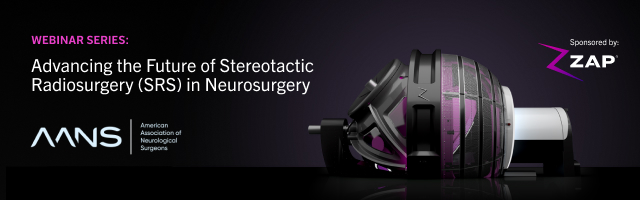
Advancing the Future of Stereotactic Radiosurgery (SRS) in Neurosurgery | Sponsored by ZAP Surgical
Stereotactic radiosurgery was pioneered by neurosurgeons — and neurosurgery has an important role in shaping what comes next.
Join leading experts for a three-part webinar series exploring the evolving role of SRS in modern neurosurgery, from essential clinical principles and multidisciplinary program development to emerging potential non-oncology applications in high precision stereotactic radiosurgery.
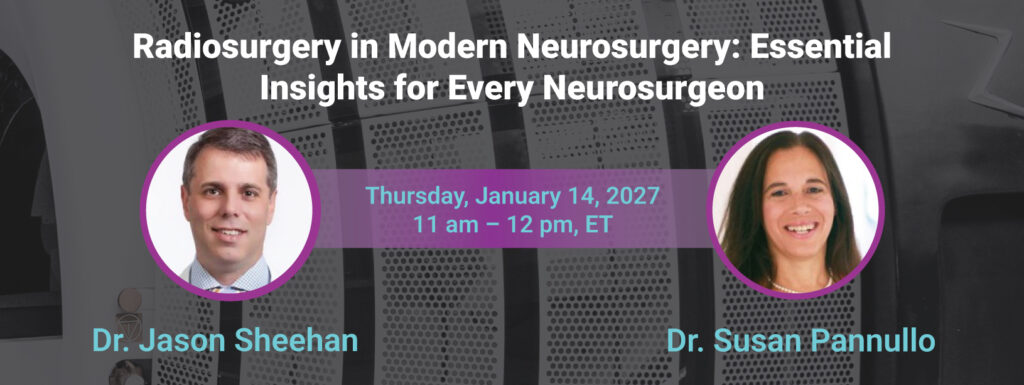
This foundational webinar explores the evolving role of stereotactic radiosurgery (SRS) in modern neurosurgical practice. Faculty will examine neurosurgery’s historic leadership in SRS, current clinical applications, safety, patient selection, salvage, and undercertainty in SRS. Additionally, the importance of SRS competency for today’s neurosurgeon, and the emerging technologies and applications shaping the future of radiosurgical care will be discussed.
In short, everything today’s neurosurgeon needs to know about SRS — and where it’s headed next.
Dr. Susan C. Pannullo is an internationally recognized clinician, researcher and educator affiliated with Columbia’s Department of Neurosurgery and Cornell’s Department of Biomedical Engineering. Board-certified in both neurology and neurological surgery, fellowship trained in neuro-oncology, and specialty focused on radiosurgery, she brings four decades of experience with diagnosis and treatment of complex neurological disorders.
Dr. Jason P. Sheehan is a Professor of Neurosurgery at the University of Virginia and an internationally recognized expert in stereotactic radiosurgery and neuro-oncology, with research focused on brain tumors, radiosurgery, and healthcare quality. He directs UVA’s Gamma Knife Center, has authored more than 250 peer-reviewed publications, and is actively involved in brain tumor research and clinical trials.
Moderated by: Dr. John R. Adler, Professor Emeritus of Neurosurgery and Radiation Oncology at Stanford Medicine, Founder and CEO of ZAP Surgical.
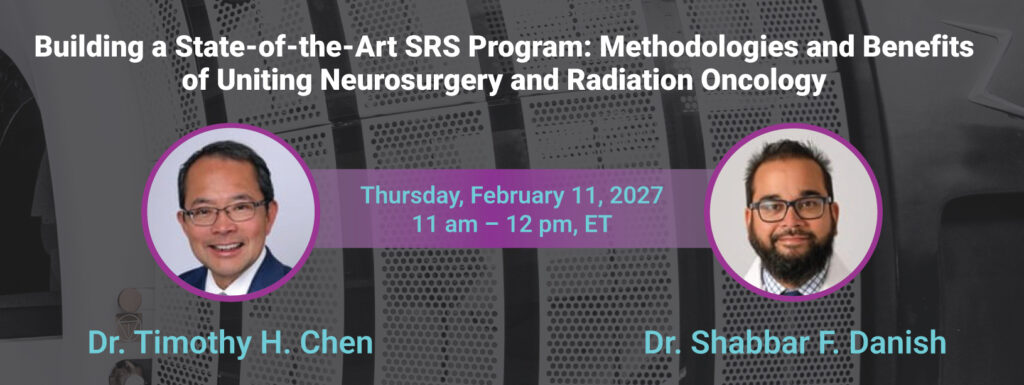
This practical webinar explores the key elements of building and sustaining a successful SRS program. Faculty will discuss collaborative models that unite neurosurgery and radiation oncology, operational considerations, multidisciplinary patient care pathways, and strategies for developing an integrated SRS program positioned for long-term success.
Dr. Shabbar F. Danish is Chair of Neurosurgery and Director of Stereotactic and Functional Neurosurgery at the Hackensack Meridian Neuroscience Institute at Jersey Shore University Medical Center, as well as Professor of Neurosurgery at Hackensack Meridian School of Medicine. A board-certified neurosurgeon, he specializes in stereotactic radiosurgery, functional neurosurgery, brain tumors, deep brain stimulation, and other advanced minimally invasive approaches to neurological disease.
Dr. Timothy H. Chen is a board-certified radiation oncologist and Medical Director of the Central Nervous System (CNS) Program at Jersey Shore University Medical Center, as well as Director of Proton Therapy for Hackensack Meridian Health. With 25 years of clinical experience, his expertise includes CNS stereotactic radiosurgery and advanced radiation oncology, and he has served as a co-investigator on multiple NCI-designated SRS projects.
Moderated by: Dr. Susan Pannullo, Adjunct Professor of Neurosurgery at Columbia University and Adjunct Professor of Biomedical Engineering at Cornell University.

This forward-looking webinar explores the neuromodulatory effects of precisely targeted low dose ionizing radiation, now referred to as “radiomodulation”. Preliminary data was recently reported from a first-in-human pilot study evaluating patients with severe treatment resistant depression (TRD) treated with radiomodulation on the ZAP-X platform. Based on encouraging early outcomes, broader multi-center clinical trials are now being planned to treat a wide variety of psychiatric disorders beginning with TRD and addiction. Read the preliminary data report here.
Neuromodulation is not a cleared indication for stereotactic radiosurgery.
Dr. John R. Adler, Jr. is a world-renowned neurosurgeon, inventor, and Founder and CEO of ZAP Surgical Systems, best known for inventing the CyberKnife® and ZAP-X® Gyroscopic Radiosurgery® platforms. A longtime Stanford University faculty member and Professor Emeritus of Neurosurgery and Radiation Oncology, he has authored more than 300 peer-reviewed publications, holds more than 20 U.S. patents, and was inducted into the National Inventors Hall of Fame in 2025.
Dr. Hemmings Wu is Chief Medical Officer at ZAP Surgical and an internationally recognized neurosurgeon and neuroscientist specializing in neuromodulation, brain-computer interfaces, and functional brain disorders. Today, Dr. Wu holds a Visiting Professor appointment with the Department of Neurosurgery at Taipei Medical University Hospital. Formerly a neurosurgeon and research professor at Zhejiang University School of Medicine, he holds a PhD in Neuroscience from KU Leuven and completed postdoctoral training in Neurosurgery at Stanford University.
Moderated by: Dr. Andres Lozano, Chairman of Neurosurgery at Toronto Western Hospital
